
The Engine Porsche Keeps Burying
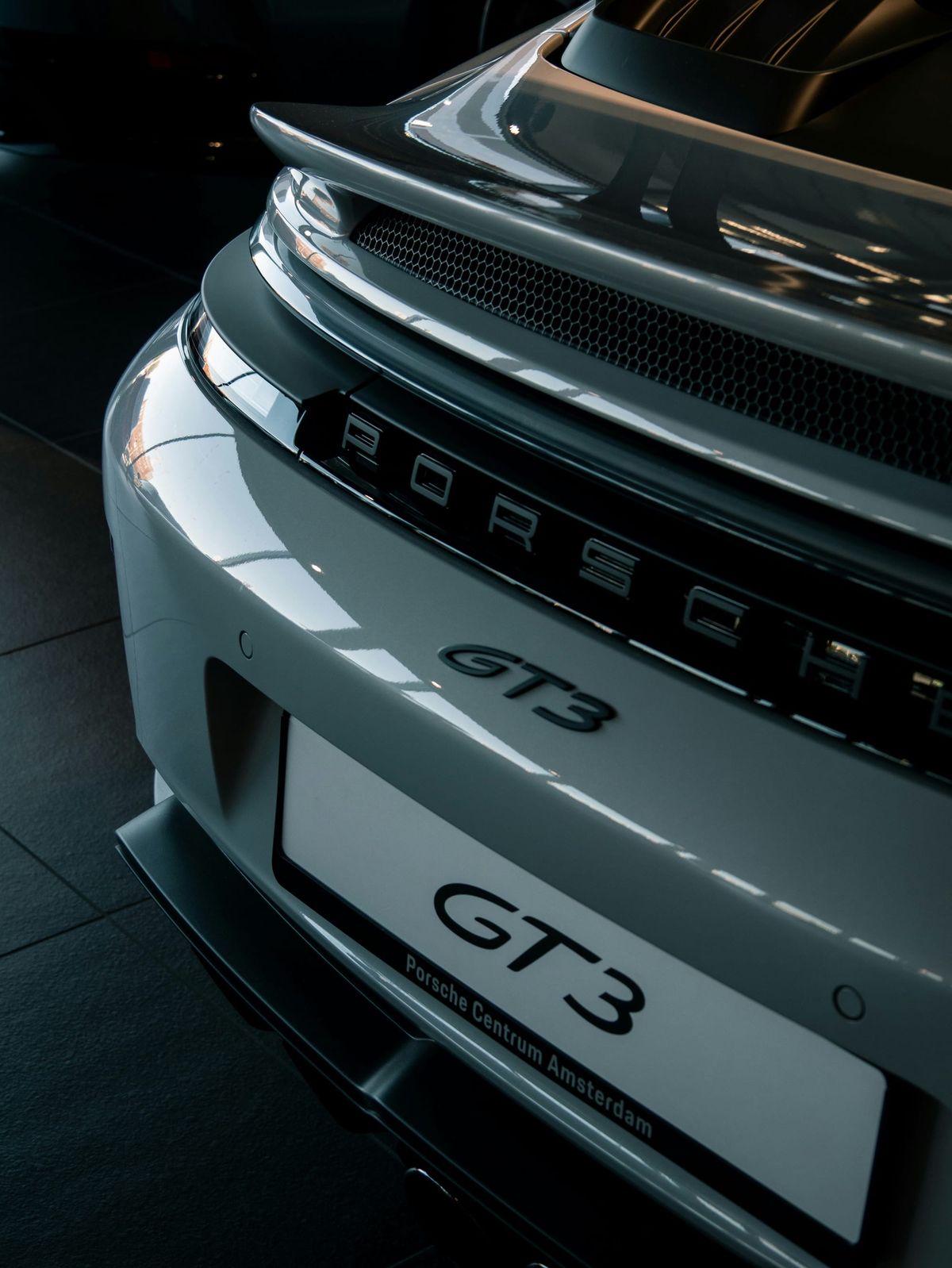
The company's GT chief gave its celebrated naturally aspirated flat-six two years to live. Public records show Porsche spent those two years building a new race car around it, lobbying Brussels for a loophole, and telling investors that scarcity was the plan.
STUTTGART: On Oct. 29, 2024, the man in charge of Porsche's GT cars gave the engine two years to live.
Andreas Preuninger was launching the latest 911 GT3, the car built around a four-liter flat-six that spins to 9,000 revolutions per minute without a turbocharger. The engine, he told Autocar, could be sold "for another two years, but it depends on the markets." After that: "I don't think we can handle Euro 7 without electrification or without turbos."
Those two years expire this October.
Meanwhile, several times a week, a 911 rolls off the assembly line at Porsche's Zuffenhausen plant that will never be registered anywhere. It is a Cup car, built for one-make racing, and it leaves the factory owing nothing to any emissions standard, noise regulation or fleet carbon target on earth. Its engine, Porsche's own materials say, "continues to be based on the power unit of the Porsche 911 GT3." A few stations down the same line, the road-going GT3 is assembled with what is, in all essentials, the same engine: the one buyers have been told is running out of time. A review of European legislative texts, government certification databases, the European Commission's lobbying disclosures, Porsche's own investor filings and United States customs manifests shows a company that behaved, at every turn, as if the engine had a long future, while its most visible executive described its imminent end.
Euro 7, the European Union's exhaust-emissions law and the regulation Mr. Preuninger blamed, does not contain the requirement he described for road cars, and it does not apply to race cars at all. The road-going engine he said could not survive it had, by the time he spoke, already been certified with wide margins on both sides of the Atlantic. Nine months after the two-year clock started, Porsche launched a new multi-season racing program built on the same power unit. And in the middle of it all, according to the Commission's own meeting log, the company sat down with the European Union's industrial-strategy chief on the subject of synthetic fuels, the very mechanism that, ten months later, appeared in Brussels' proposal to soften the 2035 combustion ban.
In the formal regulatory record reviewed for this article, the filings where claims are on paper and rebuttable, Porsche has never asserted that Euro 7 would end the naturally aspirated GT3. That claim lives only in interviews, at car launches, addressed to enthusiasts. Where Porsche did press its case, the record shows, was through quieter channels: trade associations, Commission meeting rooms, and, on at least one documented occasion, text messages with a German cabinet minister.
A Law Without the Killing Clause
The notion that Europe's seventh emissions standard would force turbochargers on Porsche's GT cars predates the standard itself. In May 2020, Frank-Steffen Walliser, then head of the 911 and 718 product lines, told The Drive that under the coming rules, "we only see a turbo solution. Naturally aspirated, not really." Even then, he allowed that such engines might survive in markets that followed American rather than European rules.
At that moment, no Euro 7 law existed. The Commission was still collecting public comments on what the future rule should say, and the scenarios under discussion, drawn up by a technical consortium advising the Commission, contemplated cutting the nitrogen-oxide limit for gasoline cars to roughly 20 milligrams per kilometer, a threefold tightening, according to comments filed by the International Council on Clean Transportation. That was the regulation Mr. Walliser's remark addressed.
It never became law. In December 2023, the Council and Parliament agreed to retain the existing Euro 6 limits for passenger cars. Regulation (EU) 2024/1257, published May 8, 2024, left the gasoline NOx limit at 60 milligrams, unchanged, while extending particle counting to smaller sizes and lengthening durability requirements to 200,000 kilometers.
What Euro 7 does add, for a car like the GT3, is modest. A denser particulate filter, which the I.C.C.T. prices in the low hundreds of dollars. An on-board monitoring regime that the implementing regulation defines as a data-reporting obligation. Brake-particle limits, the standard's one genuinely novel element, for which carbon-ceramic discs, already a Porsche option, and Brembo's coated iron discs are the existing answers.
And a concession. Article 10(4) of Implementing Regulation 2025/1706 provides that in-service conformity checks "shall not be mandatory if the annual sales of the in-service conformity family are less than 5 000 vehicles in the Union for the previous calendar year." GT3-class volumes in Europe fall well under that threshold.
The widely cited claim that Euro 7 would add €2,000 to the cost of a car traces to a study commissioned by the industry association ACEA in May 2023, against the harsher proposal that was subsequently gutted.
Mr. Preuninger's October 2024 remarks came five and a half months after the final text was published. Nothing in it obliges an engine to adopt turbocharging; if anything, turbocharging complicates particulate control and does nothing for the two constraints that do bind. In the same interview, Mr. Preuninger offered a sentence that reads differently in hindsight: "It could live forever without the laws coming."
Can Porsche Sell This Car in Europe in 2028?
Not exactly as it sits on the showroom floor today. But what stands between today's GT3 and a 2028 European price list is a parts bin and a filing cabinet, not a law of physics.
The dates work like this. Euro 7 applies to newly approved vehicle types from Nov. 29, 2026, and to every new registration from Nov. 29, 2027. The current GT3's type approval, granted under Euro 6e-bis, is untouched by the first date; Porsche can build and register the car through 2027 exactly as it is. The second date is the real one. From Nov. 29, 2027, a GT3 registered in the EU must carry a Euro 7 approval, so a 2028 European GT3 exists only if Porsche re-certifies the car.
What has to change on the car is a short list, and every item is already on a shelf. A denser particulate filter from the same two ceramics suppliers that make every filter in the industry. The on-board monitoring software and its reporting pipeline. A demonstration that the emissions hardware lasts 200,000 kilometers or ten years. Brakes that meet the 7 milligram per kilometer dust limit, which the carbon-ceramics on the options list already do. Then the paperwork: a new approval under the Euro 7 framework, a process Porsche has run mid-cycle before, most recently when it re-homologated the GT4 RS from one Euro 6 stage to the next. The engine itself, the block, the heads, the 9,000 rpm, the absence of a turbo, appears nowhere on that list, because the exhaust limits a 2028 GT3 must meet are the same Euro 6 numbers today's car already beats.
What can change around the car is a longer list, and all of it moves in Porsche's favor or against it on political calendars, not engineering ones. The Nov. 23 Parliament vote can soften the 2035 endgame and bless e-fuels as an offset, which would relieve the fleet-carbon pressure that makes each European GT3 expensive for Porsche to sell. The three-year CO2 averaging that already spared Volkswagen a multibillion-euro fine can be extended, tightened or left alone. The noise rules can move against the car: the 72-decibel limit the GT3 meets by one decibel is being reinforced with a new on-road test procedure now moving through the U.N. rule-making body in Geneva, and that is the one place where a future tightening could genuinely squeeze a 9,000 rpm engine. None of these variables is fixed, which is precisely the point. A 2028 European GT3 is a decision with a known cost, not an impossibility, and whether Porsche makes that decision will be settled in boardrooms and plenary chambers, not in the combustion chamber.
So what would the decision cost? No carmaker discloses per-model certification budgets, but the pieces can be priced from public figures. The hardware is the small part. The EU-spec GT3 already carries particulate filters, so Euro 7's finer particle rule means a denser substrate, a part the I.C.C.T. prices at roughly $106 to $154 in volume; allow €200 to €400 on a low-volume performance exhaust. The monitoring requirement is software on sensors the car largely has. The brake answer is on the shelf: carbon-ceramics already comply, and Brembo's coated iron disc was built for this deadline. Add margin for richer catalyst loading to guarantee the 200,000-kilometer durability case, and the parts bill lands around €400 to €900 per car. For reference, the European Commission's own estimate for Euro 7's direct cost on a combustion car was €180 to €450; the €2,000 figure the industry circulated was aimed at the harsher proposal that died.
The real money is the one-time work: the calibration campaign, the durability demonstration, the monitoring software validation, the brake and noise retests, the approval paperwork. Porsche must put the whole 911 line through Euro 7 regardless, so the GT3's increment is the marginal cost of certifying one engine family, a job on the order of a few dozen engineers for a year to eighteen months plus test programs. An analysis for this article puts that at €15 million to €40 million, an estimate, not a disclosed figure. Spread across a plausible European run of 6,000 to 8,000 cars, the all-in bill works out to roughly €3,000 to €7,000 per car: between 1.5 and 3 percent of what a European GT3 transacts for before options, and a fraction of the roughly €20,700 in fleet-carbon exposure each of those cars already carries under the rules in force today.
Set that number beside the 100-car Bergsport edition Porsche premiered this month, a car whose collector premium on the secondary market will likely exceed the entire per-car cost of Euro 7 compliance many times over, and the proportions of the story become clear. Making the GT3 legal for 2028 costs Porsche something like what one customer pays for a paint-to-sample color and a set of options. It is not the kind of number that kills a car. It is the kind of number a company absorbs without a press release, when it wants to.
None of this reaches across the Atlantic. The GT3 is certified in the United States by the E.P.A. and California, under rules Euro 7 does not touch, with no drive-by noise regime and no fleet-carbon penalty of the European kind. Whatever happens to the naturally aspirated GT3 in America will be Porsche's decision, not Brussels'.
What the Governments Measured
The engine's actual regulatory record is not a matter of interpretation. It is on file with two governments.
In the United States, certification data in the Environmental Protection Agency's public document index show the four-liter test groups running roughly six times under their emissions limits. In Europe, exports from the automotive industry's real-driving-emissions monitoring platform, reviewed for this article, show the current GT3 certified to Euro 6e-bis, the most stringent on-road test stage now in force, at a conformity factor of 1.0.
The constraint that does bind is acoustic. Under U.N. Regulation 51.03, every new registration in the GT3's power class since July 1, 2026 must meet a 72-decibel drive-by limit. On July 30, a customer in the Netherlands registered a new GT3, plate KRX88P. The Dutch vehicle authority's public record for that car lists a homologated drive-by value of 71 decibels.
One decibel of margin on noise; six times the margin on exhaust. That asymmetry is the whole story of what actually threatens this engine, and it is worth pausing on why. Exhaust is a chemistry problem, and chemistry can be bolted on: catalysts and filters scrub what comes out of the pipe without changing what the engine is. Noise cannot be engineered away the same way, because for this car the noise is the product. The sound of a flat-six at 9,000 rpm is a large part of what buyers are paying for, and every decibel of muffling subtracts from the thing being sold. Porsche's engineers have pushed the one problem that can be solved to a sixfold margin, and the problem that cannot be solved without diminishing the car sits one decibel from the wall. Yet the public narrative blames the side with the enormous margin and almost never mentions the side with the thin one. The thin one, it happens, has no American equivalent.
The second real constraint is carbon. At 312 grams of CO2 per kilometer against a fleet target near 94, and a penalty of €95 per gram, each GT3 registered in Europe carries a shadow cost on the order of €20,700 in fleet exposure, under the EU's CO2 regime. The Dutch buyer felt a consumer-facing version: the RDW record lists a catalog price of €398,639, roughly double the German figure, because Dutch registration tax is indexed to CO2.
Yet even that wall proved softer than advertised. The Volkswagen Group, which includes Porsche, missed its original 2025 CO2 target by about 6 grams and paid nothing, because Brussels agreed to average compliance over three years, a change that spared VW an estimated €1.7 billion to €2.2 billion in fines.
In the Room
Where Porsche's voice appears in the regulatory record is instructive for where it does not.
After the Commission adopted its Euro 7 proposal on Nov. 10, 2022, it opened a feedback window that ran to Feb. 9, 2023; the responses are listed under the "Commission adoption" stage of the initiative's page on the Commission's Have Your Say portal. One hundred eleven organizations responded. Porsche was not among them. Neither was Volkswagen, BMW or Mercedes-Benz; the German manufacturers spoke through their trade associations.
Ferrari filed under its own name. In a submission dated Feb. 9, 2023, the company argued that Euro 7 should not apply to small-volume manufacturers at all, or should take effect for them only in July 2035, citing carbon-ceramic brake dust and "the Ferraristi expectations on performance, sound and driving experience."
Porsche's approach was different. The Commission's published record of meetings with interest representatives, aggregated by the watchdog Integrity Watch, lists a Jan. 16, 2025 meeting between Executive Vice-President Stéphane Séjourné, three members of his cabinet, and "Porsche (Part of VW Group) on the future of the automotive sector." On Feb. 19, 2025, a second entry from the same cabinet reads, in full: "Meeting with Porsche on efuels."
Porsche's pursuit of the e-fuels lifeline is not new, and its most vivid documentation came out of a German courtroom. In July 2022, Oliver Blume, then Porsche's chief executive, told an internal company meeting that Porsche had played a "very large role" in getting e-fuels written into the German governing coalition's agreement, and that the finance minister, Christian Lindner, had kept him updated "almost hourly." Both men denied improper influence after the remarks leaked. But when a Berlin court ordered the release of their text messages after a two-year legal fight, the exchange from June 28, 2022, the day E.U. governments voted on the 2035 combustion phase-out, showed Mr. Lindner asking the carmaker for "argumentative support" on e-fuels, and Mr. Blume replying with "full support from Porsche's side." A European Data Journalism Network investigation into the Euro 7 lobbying campaign likewise names Porsche, alongside BMW and the German industry association VDA, as backers of the German government's push for an e-fuels derogation to the 2035 ban.
The material interest behind that push was already built. In December 2022, Porsche opened the Haru Oni synthetic-fuel plant in Chile, having invested $75 million in the developer. The plant's promised scale-up has not materialized.
On Dec. 16, 2025, the Commission proposed softening the 2035 combustion-engine ban to a 90 percent reduction, with e-fuels named as an offset. On March 4, 2026, the Commission's log records Volkswagen meeting the director-general for climate on "CO2 emission standards for light-duty vehicles." The European Parliament votes on the proposal Nov. 23, six days before Euro 7's new-type deadline.
This year a Porsche 911 GT3 Cup entered by Manthey Racing, in which Porsche holds a majority stake, has raced the Nürburgring 24 Hours and the circuit's endurance series on synthetic fuel.
The Business of Scarcity
The clearest account of why the engine's death has been so persistently announced comes not from the GT division but from Porsche's investor relations.
On March 13, 2023, with its return on sales at a record 18 percent and a long-term target of more than 20, Porsche told investors: "We will also continue to focus on limited editions and expand our Sonderwunsch programme in the future." Sonderwunsch is its bespoke-commission business. Scarcity, in other words, was a stated strategy at the top.
The years that followed were brutal. In September 2025 Porsche rescheduled its planned electric platform, dropped the all-electric plan for a new flagship S.U.V., said the Cayenne and Panamera would keep combustion engines "well into the 2030s," booked about €3.1 billion in extraordinary expenses and cut its medium-term margin ambition from 15 to 17 percent down to 10 to 15. That autumn it posted a €966 million operating loss for the third quarter, its first since listing. Its 2025 operating profit fell 92.7 percent, to a return on sales of 1.1 percent.
The 911 was the only major model line that grew.
In the first half of 2026, group deliveries fell 16.5 percent while 911 deliveries rose 19 percent. Average selling price climbed €7,000. Operating profit rose a third on fewer cars. Management credited a derivative mix "with strong shares of GTS, Turbo, and GT models."
Two days before those results, on July 27, Porsche had signed a restructuring agreement with its workforce. Five thousand jobs would go by 2035 and employees would defer pay increases for nearly a decade. In exchange, the company committed €2.1 billion to two-door sports-car production, and to Sonderwunsch.
Scarcity merchandising, then, brackets the entire collapse: announced as strategy at the peak, refinanced as survival at the trough, with the GT models named to investors as a rung on the ladder that lifted margins while volumes fell.
Five weeks after the restructuring was signed, the machinery it funded produced its next artifact. On Sept. 3, 2026, at the Arosa ClassicCar hill climb in Switzerland, Porsche premiered the 911 GT3 Bergsport, an Exclusive Manufaktur edition of 100 cars built around the same naturally aspirated four-liter engine, mechanically unchanged, with a manual gearbox. It will be sold only in Austria, France, Italy and Switzerland. Not in the United States, the GT3's largest market. Not even in Germany, where it is built.
Consider what that announcement does to the story it arrived inside. The engine that supposedly cannot survive Europe's regulations was given a special edition sold only in Europe, including two EU member states where every car in the run will carry the full fleet-carbon cost, launched twelve weeks before the Euro 7 deadline that was said to doom it and eight weeks before Mr. Preuninger's two years expire. As a variant of the existing approved type, the Bergsport is untouched by the Nov. 29 new-type date. The constraint on this car is not a regulation anywhere on earth. It is a number Porsche chose: one hundred. And the market it was withheld from is the one where the farewell story commands the highest premiums, a scarcity decision that the customs record suggests the gray market will now arbitrage one car at a time.
None of this requires Porsche to discontinue the GT3. It requires the company to ration it asymmetrically, and the Bergsport reads as the pilot program: a hundred cars, four countries, full regulatory cost per unit, absorbed without a press release about Euro 7. If the Capital Markets Day on Oct. 7, or the weeks after the Nov. 23 vote, bring an announcement that the standard GT3 leaves the European catalog while a "celebration" edition arrives, the pattern documented here will have predicted it: same engine, same line, same approval, a different number on the build plaque and a different price. The marketing logic does not merely make sense of that move. It makes anything else look like money left on the table.
Same Line, Different Rules
On Aug. 8, 2025, nine months after "two years" and with Euro 7's new-type deadline still fifteen months away, Porsche launched two new customer racing cars for 2026: a new 911 GT3 Cup on the four-liter naturally aspirated engine, and a GT3 R with a 4.2-liter version. One-make Cup generations typically run about five seasons. The Cup car is built on the same Zuffenhausen line as the road cars.
A race car is never type-approved. Euro 7 does not apply to it; neither does the 72-decibel rule, nor the fleet CO2 regime, nor the 2035 mandate. The Cup program keeps the engine's entire industrial base, the line, the tooling, the workforce, the suppliers, in production, sustained by a product no regulator can reach.
That is the honest boundary of the finding: the Cup car guarantees the engine, not the road car. Porsche could end road-going sales of the naturally aspirated GT3 tomorrow, in Europe or everywhere, and keep building the engine for customers with racing licenses. What the record shows is that the company has constructed precisely that option, and that every "last chance" campaign in the interval takes place while the same line builds the same motor.
United States customs manifests reviewed for this article show the pipeline functioning as designed: individual GT3s crossing the Atlantic to named American buyers through the summer of 2026, a GT3 RS landing in California for a customer on June 23, and, on May 27, a GT3 shipped from Tianjin to Long Beach, a car bought in China and repatriated to the market where the story commands the highest premium. The one document that would settle the engine's American future is an E.P.A. certificate for a model-year 2027 four-liter naturally aspirated test group. As of this writing, none has appeared, and none has been ruled out. That filing, whenever it comes, will say more than any interview.
The calendar now converges on a single month. Porsche's first Capital Markets Day since its 2022 listing is Oct. 7, where "concrete product plans" for the next decade have been promised. On Oct. 29, Mr. Preuninger's two years run out. Whatever is announced in that window, and whatever it is called, this record supplies the way to read it.
Because on the day the two years expire, two cars will leave the same assembly line at Zuffenhausen. One will roll onto a transporter bound for a racetrack, owing nothing to any law in this story. The other will need a denser filter, a 72-decibel certificate, a carbon offset earned by somebody else's electric car, and an allocation phone call. Same engine. Same line. Same hands that built it. The only difference between the two is paperwork, and the paperwork is a choice.
If Porsche ends the naturally aspirated GT3 this fall, in Europe or everywhere, the announcement will be reported as an obituary, and the prices will move the way prices move at funerals. It will not be an obituary. The engine will still be in production that afternoon. What will have ended is permission, in the markets where withholding it pays best. That is not a death. That is a price.
Timeline: What Porsche Said, and What Porsche Did
May 18, 2020. Walliser: Euro 7 leaves "only a turbo solution." No Euro 7 law exists yet; the Commission is still collecting public comments, and the version under discussion is roughly three times stricter than what eventually passed. (The Drive)
June 28, 2022. The day E.U. governments vote on the 2035 phase-out, Finance Minister Lindner texts Porsche CEO Blume asking for "argumentative support" on e-fuels; Blume: "full support from Porsche's side." Released by court order in 2024. (abgeordnetenwatch)
July 2022. Blume tells a Porsche works meeting the company played a "very large role" in the coalition's e-fuels position; he later calls the wording overstated. (abgeordnetenwatch)
Sept. 29, 2022. Porsche IPO at €82.50. (Porsche IR)
Dec. 20, 2022. Haru Oni e-fuel plant opens; $75 million invested. (Porsche)
Feb. 9, 2023. Euro 7 public feedback closes. 111 filers. Ferrari files; Porsche and VW do not. (EU Have Your Say)
March 13, 2023. Return on sales 18 percent; long-term target above 20. "We will also continue to focus on limited editions and expand our Sonderwunsch programme." (Porsche)
May 23, 2023. ACEA publishes the "€2,000 per car" cost study against the proposal. (ACEA)
Dec. 18, 2023. Council and Parliament agree: cars keep Euro 6 limits. (Council)
May 8, 2024. Euro 7 published. Gasoline NOx limit unchanged; PN10 particle counting; 200,000 km durability; brake limit 7 mg/km. (EUR-Lex)
Oct. 29, 2024. Preuninger: "two years... but it depends on the markets." (Autocar)
Jan. 16, 2025. Porsche meets E.V.P. Séjourné on "the future of the automotive sector." (Integrity Watch)
Feb. 19, 2025. "Meeting with Porsche on efuels." (Integrity Watch)
July 30, 2025. Second profit-guidance cut of the year. (Bloomberg)
Aug. 8, 2025. New 911 GT3 Cup (4.0 NA) and GT3 R (4.2 NA) launched for 2026. (Porsche Motorsport)
Sept. 19, 2025. EV platform rescheduled; Cayenne and Panamera to keep combustion "well into the 2030s"; margin ambition cut from 15-17 percent to 10-15; about €3.1 billion in extraordinary expenses. (VW ad-hoc)
Oct. 27, 2025. Q3 operating loss of €966 million, the first since listing. (CBT News)
Dec. 16, 2025. Commission proposes 2035 at a 90 percent cut with e-fuel offsets. (Euronews)
Jan. 22, 2026. Next GT3 RS prototype read as turbocharged. (autoevolution)
Jan. 29, 2026. Preuninger's dream cars: "The S/T and the GT3 RS." (Top Gear)
March 2026. FY2025 results: operating profit down 92.7 percent; return on sales 1.1 percent. (Investing.com)
March 4, 2026. VW meets the DG CLIMA director-general on "CO2 emission standards for light-duty vehicles." (Integrity Watch)
May 27, 2026. GT3 shipped Tianjin to Long Beach. (U.S. bill of lading, on file.)
June 23, 2026. GT3 RS delivered to a named California customer. (U.S. bill of lading, on file.)
June 25, 2026. EEA: 2025 EU new-car CO2 average 96.7 g/km. (EEA)
July 1, 2026. The 72 dB Phase 3 noise limit applies to all new registrations. (Reg. 540/2014)
July 27, 2026. "Future Package": 5,000 jobs cut; pay deferrals to 2035; €2.1 billion to two-door production and Sonderwunsch. (Yahoo Finance)
July 29, 2026. H1 results: deliveries down 16.5 percent, 911 up 19 percent (30,534), average price €119,000 to €126,000, operating profit up 33.9 percent, "strong shares of GTS, Turbo, and GT models." (Porsche)
July 30, 2026. GT3 plate KRX88P registered in the Netherlands: 71 dB; Euro 6e-bis; €398,639. (RDW)
Sept. 3, 2026. The 911 GT3 Bergsport premieres at the Arosa ClassicCar hill climb: 100 units, Exclusive Manufaktur, the same NA engine unchanged, sold only in Austria, France, Italy and Switzerland. Not the U.S., not Germany. (Porsche Newsroom; Carscoops)
Oct. 7, 2026. Capital Markets Day, the first since 2022.
Oct. 29, 2026. The two years expire.
Nov. 23, 2026. Parliament votes on the 2035 revision. (EP)
Nov. 29, 2026. Euro 7 applies to newly approved vehicle types. The current GT3's existing approval is unaffected. (Reg. 2024/1257)
Nov. 29, 2027. Euro 7 applies to all new registrations in the EU. The date by which the GT3 must be re-certified or withdrawn from European sale. No effect in the United States.